Roseanne Kariuki explores the hidden contagion of suicide, highlighting how exposure can quietly affect vulnerable individuals.
Roseanne Wanjiru Kariuki is a rising voice in mental health and suicide prevention, bringing clarity and psychological insight to a topic often misunderstood. A counselling psychology trainee, she currently works with survivors of gender-based violence and provides support to teenage girls in high schools, guiding them through complex emotional challenges with care and expertise.
In this Suicide Prevention and Awareness Month, Kariuki sheds light on the “hidden contagion” of suicide, using her experience to help communities understand how exposure to suicide can affect vulnerability and how awareness can be both responsible and life-saving.

“My name is Roseanne Wanjiru Kariuki, I am a counselling psychology trainee. Currently working in an organization that supports survivors of Gender Based Violence as well as counselling teenage girls in high schools.”
Roseanne Kariuki
In the context of suicide prevention, Roseanne Kariuki sheds light on a concept she describes as the “hidden contagion.”
“When we say suicide is a ‘hidden contagion,’ we mean hearing about or being close to someone’s suicide can quietly increase the risk for others,” she explains.
Unlike a physical illness, suicide doesn’t spread in the literal sense, but the ideas, stories, or even the way a case is presented can influence those already struggling with feelings of hopelessness or isolation.
“If someone is already experiencing thwarted belongingness or perceived burdensomeness, seeing a suicide in their family, school, friend group, or in the media can make them think of it as an option,” Kariuki says. She emphasizes the importance of sensitive and responsible reporting.
Research indicates that exposure to suicide can significantly increase the risk of suicidal thoughts and behaviors. A systematic review and meta-analysis found that exposure to suicide was associated with increased odds of suicide attempts (OR = 3.53) and suicide deaths (OR = 3.23). Additionally, studies have shown that suicide clusters, groups of suicides occurring in close proximity, account for approximately 1% of suicide attempts and 0.6% of suicides, highlighting the impact of contagion effects.
Media Guidelines to Prevent Copycat Suicides
Organizations like the American Foundation for Suicide Prevention (AFSP) and the Suicide Prevention Resource Center (SPRC) have developed ethical reporting guidelines to minimize the risk of suicide contagion. Key recommendations include:
- Avoiding Detailed Descriptions: Refrain from providing specific details about the method or location of a suicide. Such information can serve as a model for vulnerable individuals.
- Using Sensitive Language: Opt for terms like “died by suicide” instead of “committed suicide,” which can carry negative connotations.
- Focusing on the Life, Not Just the Death: Highlighting the individual’s life, struggles, and the impact on loved ones can provide a more balanced perspective.
- Including Resources: Providing information about suicide prevention resources and hotlines can offer support to those in need.
Studies have shown that implementing these media guidelines can be effective in reducing the incidence of suicide following media coverage. For instance, a study examining the effects of celebrity suicides in South Korea found that media guidelines and suicide prevention laws led to a significant decrease in suicide rates following such events.
Some countries have enacted laws to regulate media reporting on suicide. In South Korea, the government implemented a suicide prevention law in 2012 and revised media guidelines in 2013 to address the issue of copycat suicides. These measures have been associated with a reduction in suicide rates following media coverage of celebrity suicides.
Kenya’s Media Failing on Suicide Reporting
A 2025 study conducted by Moi University researchers found that Kenyan media often fail to adhere to World Health Organization (WHO) guidelines on suicide prevention. Newspaper reports frequently include detailed descriptions of suicide methods and sensationalized imagery, which can inadvertently encourage imitative behavior among vulnerable individuals. The study recommends that the Media Council of Kenya and media houses develop robust guidelines to minimize harm and promote responsible reporting.
Even with existing media guidelines meant to prevent copycat suicides, such as avoiding detailed descriptions of methods, breaches are common. Bloggers and some media outlets often sensationalize cases or share graphic imagery, exposing vulnerable individuals to harmful triggers.

Kariuki’s insights make it clear that talking about suicide is delicate work; raising awareness alone isn’t enough. How we communicate, the words we choose, the images we show, the stories we tell, can either protect or put vulnerable people at risk.
The Hidden Contagion
While suicide is often discussed in terms of statistics and prevention programs, its psychological ripple effects remain less visible. Roseanne Kariuki explains that exposure to suicide can quietly heighten vulnerability for those already struggling. When someone loses a loved one, witnesses a peer’s death, or even consumes media coverage of suicide, the act can start to feel familiar, even possible.
“Most people have a natural psychological barrier that keeps suicide in the ‘unthinkable’ category,” Kariuki notes. “But when they are exposed, either through a loved one, their community, or media coverage, this barrier can weaken. It shifts from ‘I would never do that’ to ‘maybe this is an option.’”
Roseanne Kariuki
She describes this process as modeling: seeing or hearing about another person’s suicide can give vulnerable individuals ideas about how to act on their own pain. On a personal level, losing someone to suicide can intensify feelings of grief, guilt, or hopelessness, further increasing risk.
The way stories are told matters just as much as the exposure itself. Imitation effects occur when someone identifies with a person who has died by suicide, potentially replicating aspects of their behavior, from the method to the idea that suicide is a way out of suffering.
Narrative framing, Kariuki explains, shapes whether a story protects or harms. A narrative that romanticizes or frames suicide as inevitable can increase vulnerability, while one that sensitively highlights struggles, recovery options, and available support can promote resilience. In this sense, the same story can either deepen risk or serve as a lifeline, depending on how it is communicated.
Prevention in Practice

Preventing suicide contagion requires more than awareness, it demands careful, thoughtful communication. Roseanne Kariuki emphasizes that prevention messaging must strike a delicate balance: raising awareness without increasing risk.
“We need to avoid graphic details and sensational language,” she says, “and instead focus on messages of hope, recovery, and support.”
Campaigns can highlight that while many people struggle, help and healing are possible. Including resources like suicide helplines, counseling options, support groups, or community networks ensures that anyone triggered knows exactly where to turn. Using real stories of resilience, rather than focusing solely on loss, shifts the conversation from despair to hope.
It’s high time that Kenya starts planning events and interventions to address this issue proactively. Communities, schools, workplaces, and media outlets all play a critical role in shaping how suicide is discussed. Training, awareness campaigns, and structured dialogues can equip people to respond thoughtfully and prevent the ripple effects of exposure.

Similar initiatives have been seen internationally, such as a virtual event hosted in Glasgow in April 2021, where over 60 participants came together to discuss suicide contagion and safe reporting. On 28 April 2021, the City Health and Social Care Partnership (HSCP) and the Glasgow Council for Voluntary Sector (GCVS) hosted a virtual event on suicide contagion, attended by over 60 participants. Experts explained that exposure to suicide, through loved ones, community incidents, media reports, or even fictional portrayals, can increase suicidal thoughts and behaviors. They highlighted that media reports detailing suicide methods can raise deaths using the same method by as much as 30%. The event highlighted the importance of raising awareness responsibly, training community members, and prioritizing compassionate communication.
Families, schools, and communities also play an essential role in noticing warning signs among those recently exposed to suicide. Kariuki points out that changes in behavior can be subtle or dramatic: withdrawing from friends, losing interest in activities, discussing death or hopelessness, giving away belongings, or noticeable changes in sleep and appetite can all signal risk.
“Sometimes the signs are subtle, a person may become unusually quiet, irritable, or even seem suddenly okay after a hard period,” she notes. Supportive conversations and gentle check-ins are essential, as some individuals can hide their pain remarkably well.
Effective interventions require a coordinated, empathetic response. Bringing together families, schools, community leaders, and health workers to share accurate information and provide support can make a significant difference. Vulnerable individuals, such as close family members or friends of the deceased, should be connected to counseling and safe spaces to talk.
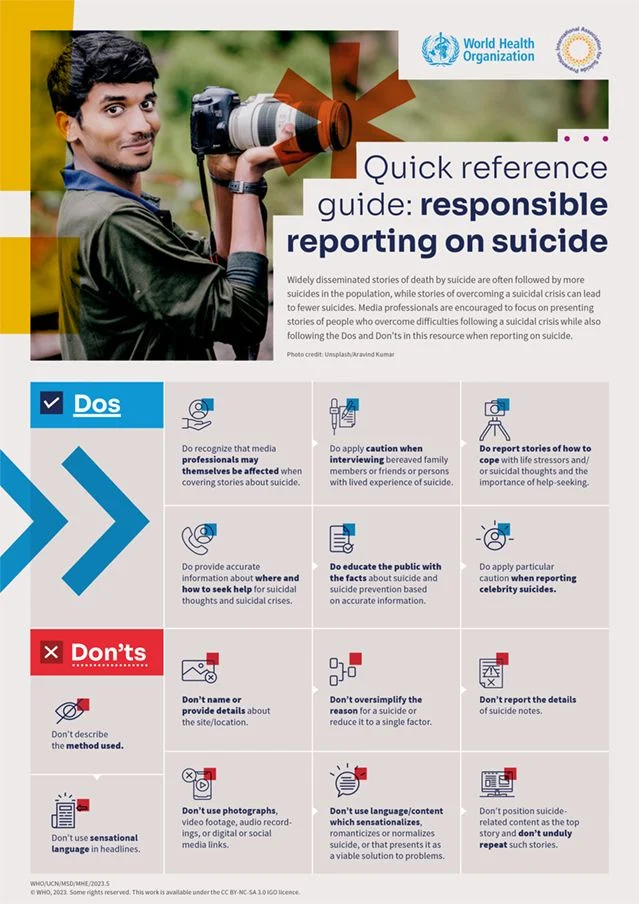
Guiding how the stories of suicide are shared. How the story is shared matters just as much, avoiding graphic details and sensationalism while highlighting hope, healing, and available resources can make a real difference. When implemented promptly, these strategies not only reduce contagion risk but also create a space where people feel seen, supported, and able to start recovering.
A Vision for Responsible Awareness

For Roseanne Kariuki, the future of suicide prevention lies in creating a culture where talking about suicide is not taboo, but done with care and compassion. She envisions a society capable of holding two truths at once: acknowledging the reality of suicide while being intentional about how we communicate it.
For her, this means shifting away from silence or sensationalism toward balanced conversations, discussions that recognize pain but also highlight healing, resilience, and the resources available for support. She hopes for a time when workplaces, families, and media professionals all feel equipped to discuss suicide in ways that do not harm, but instead open doors for connection and care.
“If we can normalize asking, ‘Are you okay?’ and truly listening, then awareness becomes prevention in itself,” she notes.
“At the end of the day, talking about suicide responsibly is really about reminding people that even in deep pain, and there is always hope. There is help. There is hope.”
Roseanne Kariuki
Responsible dialogue is about offering hope and support to those experiencing pain. There is help. There is hope. And through thoughtful conversations and intentional reporting, society can transform awareness into meaningful prevention.
Roseanne Kariuki has provided crucial insights, reminding us that talking about suicide matters, but how we talk about it matters even more. For those in the media and public platforms, there is a responsibility that comes with reporting: awareness alone is not enough. We must move away from sensational headlines and graphic portrayals that can harm vulnerable individuals. Instead, let’s focus on reporting responsibly, providing context, hope, and resources for support. When done right, these conversations remain relevant, informative, and protective for our communities. It’s time we prioritize responsibility alongside advocacy and ensure every discussion around suicide contributes to understanding, prevention, and healing.

- The Rise of Suicide Posts in Digital Spaces Reflects a Growing Mental Health Crisis - February 22, 2026
- How Kenya’s Silent Lifestyle Disease Crisis Is Reshaping Public Health - February 12, 2026
- The Rise of Lifestyle Diseases Emerges as a Crisis Among Kenya’s Youth - February 9, 2026
