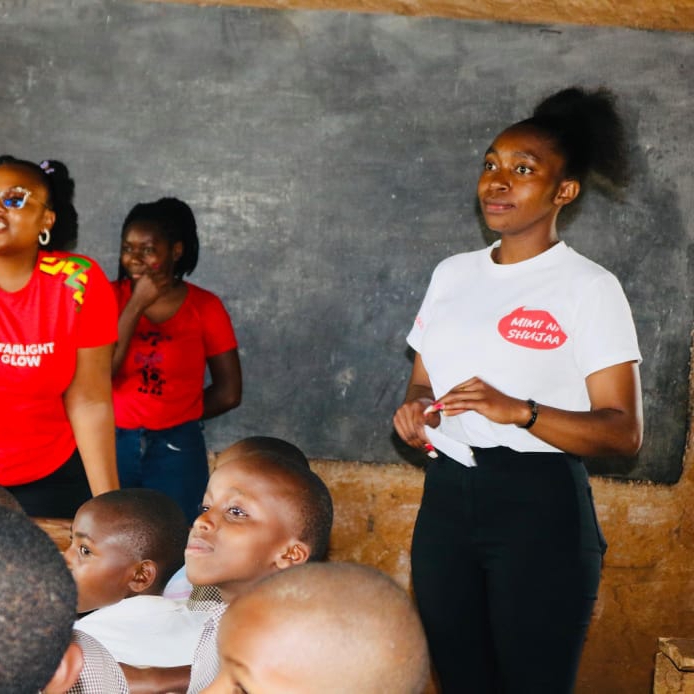
Carolpilly Gitahi is a name that resonates with purpose and passion. At just 26, she is a Junior Secondary School teacher in Murang’a County, a girl-child advocate for menstrual hygiene, an aspiring therapist and counsellor, and a part-time student of Guidance and Counselling at the University of Nairobi. But beyond the titles, Wangechi’s true identity is grounded in her role as a mental health advocate, one whose mission was born from lived experience. She is actively creating awareness in schools, churches and community based events especially youth forums.
“My journey into mental health has been personal and a winding path of self-advocacy, healing, and growth. It has encompassed acceptance, insight, commitment, self-awareness and coping skills, and thus building a fulfilling life despite the challenges that came along.”
It is this personal journey that gives Wangechi’s advocacy its raw authenticity. Her experiences have shaped a commitment to not only heal herself but extend that healing to others, especially young people navigating life’s uncertainties.
When asked what first stirred her into action, Wangechi’s answer was very honest about the state of her surroundings:
“We are living in difficult and hard times, economically, socially, physically, and health-wise. People are stressed and depressed. Families are broken and disintegrated. Children feel unsafe and left out. Suicide in my community is the order of the day.”
This clarity of observation led her to see a gap, a vacuum where emotional safety and community care should exist, especially for the youth.
“Parents and guardians are so busy nowadays. Children and youths have nobody to feel safe in. There was a dire need to fit into that vacuum and into their world.”
In response, Carolpilly didn’t wait for change, she initiated it. As an educator and societal mirror, she began forming peer support groups and educational workshops in schools, churches and community forums. These spaces aimed to raise awareness on the importance of mental well-being and, perhaps most importantly, to “prioritize and empower youth in addressing stigma and misconceptions surrounding mental health.”
In Wangechi’s world, advocacy is a lifeline. One she first threw to herself, and now tirelessly extends to her community.
Advocacy in Action
Carolpilly Gitahi’s commitment to mental health advocacy moves beyond words into impactful community action. Among her most memorable volunteering experiences was during the peak of the COVID-19 pandemic in 2020. Partnering with JOYLYN FOUNDATION, she and her peers worked tirelessly to support vulnerable populations.
“We donated masks and sanitizers to the elderly as well as menstrual hygiene materials to girls in order to curb teenage pregnancies among school-going children,” Carolpilly recalls. “We also created awareness on the importance of speaking up if they were sick or distressed during the pandemic that carried a lot of stress.”
This act of service combined practical aid with mental health education, addressing both physical safety and emotional well-being in an unprecedented time of crisis.
In 2024, Carolpilly took leadership further by launching a girl-child sensitization project under STARLIGHT GLOW KENYA to commemorate World Menstrual Day. This initiative aimed at inclusivity and education within the community.
“We donated menstrual hygiene products to over 100 girls and tissues to boys to ensure inclusion for all,” she explains. The initiative included peer counselling sessions where the importance of good mental health was emphasized, alongside demonstrations on proper menstrual hygiene use. “The remaining products were left in schools to help students in the future, ensuring no child misses school due to period poverty.”
Carolpilly Gitahi and some members from the Startlight Glow Kenya Team on Pad drive World Menstual Day 2024
Balancing theory and practice is a critical skill Carolpilly has honed on her journey. She views classroom knowledge as the foundation, but real-life advocacy as the place where theory is tested and transformed into meaningful action.
“Balancing mental health theory with real-world advocacy involves applying classroom knowledge to practical situations while grounding into ethical considerations,” she explains.
She elaborates on how this balance plays out in her work:
Building Supportive Networks: Collaborating with fellow advocates to share resources and strengthen collective impact.
Continuous Learning and Reflection: Staying updated with current research and integrating feedback from those impacted by her work to maintain relevance and effectiveness.
Addressing Stigma: Actively challenging negative stereotypes by reframing language, for example, encouraging the phrase “I am healing from depression” instead of “I am suffering from depression.” She also shares her own story of overcoming postpartum depression to normalize mental health struggles.
Carolpilly believes psychology students, and those with knowledge of mental health, hold a unique responsibility in their communities.
“Psychology students have a unique responsibility because through psychology, one gains insight into why people think and behave the way they do,” she states. This understanding not only deepens self-awareness but also informs how to maintain client autonomy, cultural sensitivity, and a non-judgmental approach.
She highlights the critical role psychologists play:
“Psychologists study behavior and brain functioning by observing, interviewing, and surveying individuals. They help identify psychological, emotional, behavioral, or organizational issues and diagnose disorders such as anxiety and depression.”
By leveraging this knowledge, psychology students like Carolpilly Gitahi are well-positioned to shape conversations, dismantle stigma, and promote mental wellness in their communities.
What it Means to Create Safety and Connection
For Carolpilly Gitahi, creating a safe space goes far beyond simply welcoming others, it’s about creating an environment where individuals feel genuinely secure and empowered.
“A safe space is a supportive, non-threatening environment where individuals feel comfortable, secure, empowered, and supported to express themselves, share personal experiences, and explore difficult emotions without fear of judgment or discrimination”
Key elements she emphasizes include trust, respect, confidentiality, emotional intelligence, and clear boundaries. The physical environment itself must also be conducive, comfortable and free from distractions.
“In my school, I created a safe space called ‘ONGEA USIKIKE’ as a club where peers can interact freely.”
It is imperative that teachers recognize the urgent need to establish safe spaces like ‘ONGEA USIKIKE’ (which means “Speak and Be Heard”) within schools. Many students silently carry burdens, emotional struggles, trauma, or difficult home situations, that they cannot openly discuss with parents or authority figures due to fear, stigma, or lack of trust. This silence can lead to serious consequences, including mental health crises and academic decline. Creating dedicated spaces where students can speak freely and receive peer support is very essential. This is a challenge to educators: step up and learn from examples like Gitahi’s initiative. By actively promoting these environments, teachers can play a transformative role in breaking down barriers, promoting healing, and ensuring no student feels isolated or unheard. The future of our youth depends on it.
Carolpilly Gitahi with Starlight Glow Kenya team, promoting safe spaces
Emotional safety, she adds, is essential for effective mental health advocacy, especially in spaces like classrooms, clubs, and informal circles.
“As a teacher, I promote a culture of trust and respect through positive greetings, open communication forums, and the art of active listening,” she says. Her methods include encouraging self-awareness and reflection through journals, meditation, and peer feedback.
The impact of these safe spaces has been tangible. One of Carolpilly’s most memorable moments was witnessing a shy girl, previously burdened by family issues and low self-esteem, transform into a confident participant.
“One important and most memorable moments that really felt safe as I created awareness was when I realized a girl that was ever quite, feeling bad about themselves and had family issues with time started having self efficacy ,got positive self-esteem. She could also raise her hand and engage in class. Additonally girls that had really suffered of discrimination due to period poverty started being confident, tidy and smiley for having donated menstrual hygiene products to them.”
Shifting Minds, Changing Culture
Challenging Stigma and Finding Her Voice
Explaining mental health to those unfamiliar with it can be daunting, but Carolpilly Gitahi approaches this challenge with clarity and compassion.
“I have had to explain mental health to people with no background or awareness. For example, in my community, suicide cases are rising, and many assume this is normal. I explain that there are underlying causes for suicide,” she says. “I also enlighten learners about stress and how it can escalate into untreated mental health conditions.”
Addressing cultural and generational stigma has posed some of her greatest challenges:
Carolpilly explains,
“People’s reluctance to seek professional help is common. Mental health issues are often viewed in my community as personal failings or weaknesses rather than legitimate health concerns.”
She acknowledges how difficult it is to change mindsets, especially among those without personal experience:
“Reauthoring this has been difficult to individuals that are illiterate or haven’t had personal experiences in issues pertaining mental health.”
Access barriers adds another layer:
“Limited access to resources and care is a big challenge. The older generation may have little or no access to mental health resources, and travel expenses to health facilities can be financially draining, especially in marginalized areas with impassable roads.”
Cultural and religious influences don’t make it any easier:
“Some Akorino churches discourage seeking professional help, and many communities attribute mental illnesses to supernatural causes like curses. This hinders effective advocacy and treatment.”
Through this journey, Carolpilly has gained profound self-awareness and patience:
“Mental health initiatives have taught me ways to improve my self-esteem, understand my emotions, and manage them effectively,” she shares.
“I’ve forcefully learned the virtue of patience, sometimes it’s good to pause, return to myself, and let silence heal the places that ache.”
Carolpilly hopes she is not alone, that many others, in their own quiet and courageous ways, are working to change the mental health narrative from the grassroots. She believes that by openly sharing her journey, the struggles, the healing, and the small victories, others may find the strength to rise, to keep going, and to keep speaking.
Carson Anekeya is a Digital Journalist and feature writer at EpicPulse Magazine, passionate about digital storytelling that highlights special features, health, mental health, and social impact. His work spans powerful narratives and evidence-based reporting, aimed at educating, inspiring, and driving meaningful change.
Contains information related to marketing campaigns of the user. These are shared with Google AdWords / Google Ads when the Google Ads and Google Analytics accounts are linked together.
90 days
__utma
ID used to identify users and sessions
2 years after last activity
__utmt
Used to monitor number of Google Analytics server requests
10 minutes
__utmb
Used to distinguish new sessions and visits. This cookie is set when the GA.js javascript library is loaded and there is no existing __utmb cookie. The cookie is updated every time data is sent to the Google Analytics server.
30 minutes after last activity
__utmc
Used only with old Urchin versions of Google Analytics and not with GA.js. Was used to distinguish between new sessions and visits at the end of a session.
End of session (browser)
__utmz
Contains information about the traffic source or campaign that directed user to the website. The cookie is set when the GA.js javascript is loaded and updated when data is sent to the Google Anaytics server
6 months after last activity
__utmv
Contains custom information set by the web developer via the _setCustomVar method in Google Analytics. This cookie is updated every time new data is sent to the Google Analytics server.
2 years after last activity
__utmx
Used to determine whether a user is included in an A / B or Multivariate test.
18 months
_ga
ID used to identify users
2 years
_gali
Used by Google Analytics to determine which links on a page are being clicked
30 seconds
_ga_
ID used to identify users
2 years
_gid
ID used to identify users for 24 hours after last activity
24 hours
_gat
Used to monitor number of Google Analytics server requests when using Google Tag Manager