In a world that often places mental health professionals on expectations of emotional perfection, Ruth Akindeko Titilayo reminds us that even the healers carry wounds. A passionate mental health advocate and recent psychology graduate from Obafemi Awolowo University, Ruth is already contributing meaningfully to mental health reform in Nigeria.
Whether volunteering with Mentally Aware Nigeria Initiative (MANI) or interning at a neuropsychiatric hospital in Lagos, she is stepping into difficult spaces, holding space for others while working through her own healing journey.
In this heartfelt conversation, Ruth opens up not just as a psychology student, but as a young woman learning to balance personal struggle with professional strength.
The Person Behind the Profession
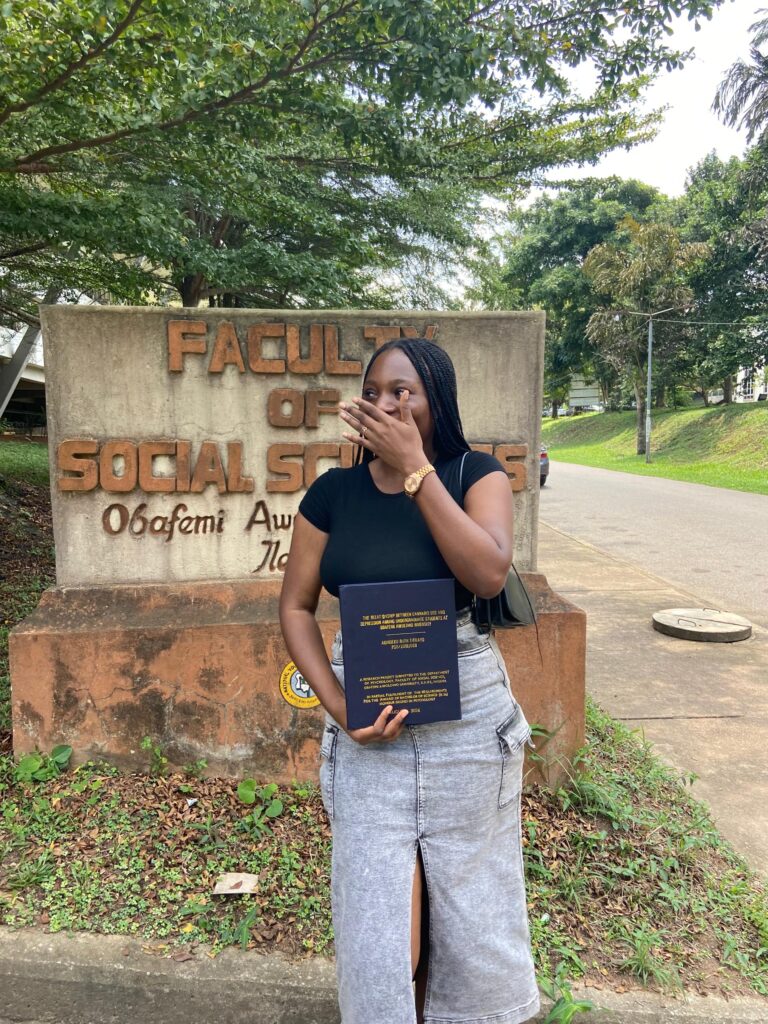
“Hi, I’m Ruth Akindeko Titilayo and in my mid-twenties. I recently graduated with a degree in Psychology from Obafemi Awolowo University, Nigeria. I’m currently undergoing a voluntary internship programme at a Neuropsychiatric Hospital in Lagos.”
Ruth Akindeko
This phase, she explains, has helped bridge the gap between theory and practice, allowing her to “witness psychology in action” beyond the classroom.

“This experience has given me the opportunity to see psychology and counselling in action. It’s been an interesting shift, from learning theoretical psychological principles in the four walls of a classroom to experiencing psychology in a clinical setting and witnessing its real-life impact.”
Ruth Akindeko Titilayo
Ruth’s heart for advocacy is evident in her commitment to Mentally Aware Nigeria Initiative (MANI), a youth-led organization tackling mental health stigma.
“I also volunteer with Mentally Aware Nigeria Initiative (MANI), supporting their goal of fighting mental health stigma and providing counselling services to those in need.”
Ruth Akindeko Titilayo
“Through MANI, I can meaningfully contribute to advocacy for change in Nigeria’s mental healthcare system, which, I might add, is in need of a major overhaul.”
Her words reflect a deep hope for transformation and a willingness to be part of that change.
But behind this passionate voice is also someone who has had to weather internal storms.
Ruth Akindeko Titilayo speaks candidly about the pressure psychology students often feel, to be the ones who always “have it together.” She reflects,
“My time at university was quite tough. I always tried to maintain the illusion of having it together, even when overwhelmed. Because I was a psychology student, I felt I should just “read a textbook and get it together.” But sadly, it’s harder to remember and apply textbook knowledge during moments of distress.”
Ruth Akindeko Titilayo
That pressure eventually led her into a spiral of anxiety and depression.
One memory still lingers vividly:
“I clearly remember one time when it got too bad: I was on a motorcycle heading home, in tears, feeling like I couldn’t go on. University was an experience of its own and it truly tested my mental wellbeing.”
Ruth Akindeko
Her honesty breaks the myth that those who understand mental health are immune from its struggles. Through this vulnerability, Ruth sets the stage for a deeper conversation, about the heavy emotional load psychology students quietly carry when no one’s watching.
When the Helper is Hurting
The Weight of Expectations
The weight of expectations, especially those we place on ourselves, can be one of the heaviest burdens to carry. For Ruth Akindeko, this became painfully evident during her first-semester 400-level exams (Fourth-year). From her earliest days at university, she had one goal: to graduate with a first-class degree in psychology.
“My first-semester 400-level exams are forever etched in my brain. From my very first step at university, my goal was to graduate with a first-class CGPA. I reminded myself of this every new semester and worked to the best of my abilities to achieve it.”
Ruth Akindeko
That ambition drove her academic journey, semester after semester. Some terms were excellent, others less so, but the vision remained constant, until the numbers no longer aligned with the dream. By the end of her third year, the first-class distinction had drifted into the rearview mirror, and with it came a creeping sense of self-disappointment.
As her final year began, Ruth found herself fighting a quiet battle. The pressure to meet her academic expectations morphed into mental exhaustion, and while she believed she was managing the weight well, after all, she was a psychology student trained in coping mechanisms, reality told a different story.
“At the start of my final session, I realised I was struggling to cope with the self-imposed mental stress to be better. I thought I had it under control, after all, I was a psychology student actively applying the coping skills we’d been taught, right? I didn’t want to appear like I was struggling, but some people noticed and pointed it out.”
Ruth Akindeko
During exams, her body betrayed her. Despite thorough preparation, she would shake uncontrollably or experience stomach discomfort that vanished only after walking out of the hall. The anxiety she thought she had buried surfaced in full force. It wasn’t a lack of knowledge, it was the overwhelming tension of fearing she might never reach the ideal she had held onto for so long.
“Anxiety and fears I thought I’d buried came roaring back: how could I reach my goal if I got brain fog the moment I saw the questions? For lack of a better phrase, it was hell.”
When asked, “How did your own mental health challenges shape your view of the psychology field or your role in it? Did it ever make you question your career path, or did it affirm it?” Ruth says;
“On the hardest days, I found myself questioning everything, what was the point of studying how to manage mental health if I was still struggling myself? I wondered how I could ever support others when I hadn’t fully figured myself out. How could I help others if I couldn’t help myself? I questioned whether this was truly my career path, yet I deeply loved studying psychology?”
Ruth Akindeko
There were moments when she questioned whether she was cut out for this line of work. But those questions, instead of breaking her, eventually clarified her purpose. Her personal struggles didn’t disqualify her from helping others, they qualified her in a different, deeper way. She came to understand that walking through mental health challenges firsthand made her more empathetic, more human, and more capable of meeting others where they were. She began to see herself not just as a student of psychology, but as someone who could sit in the darkness with others because she knew how it felt.
“I knew there were people like me experiencing these same issues, and I wanted to help. At the end of the day, we’re all humans struggling in different ways.”
Ruth Akindeko
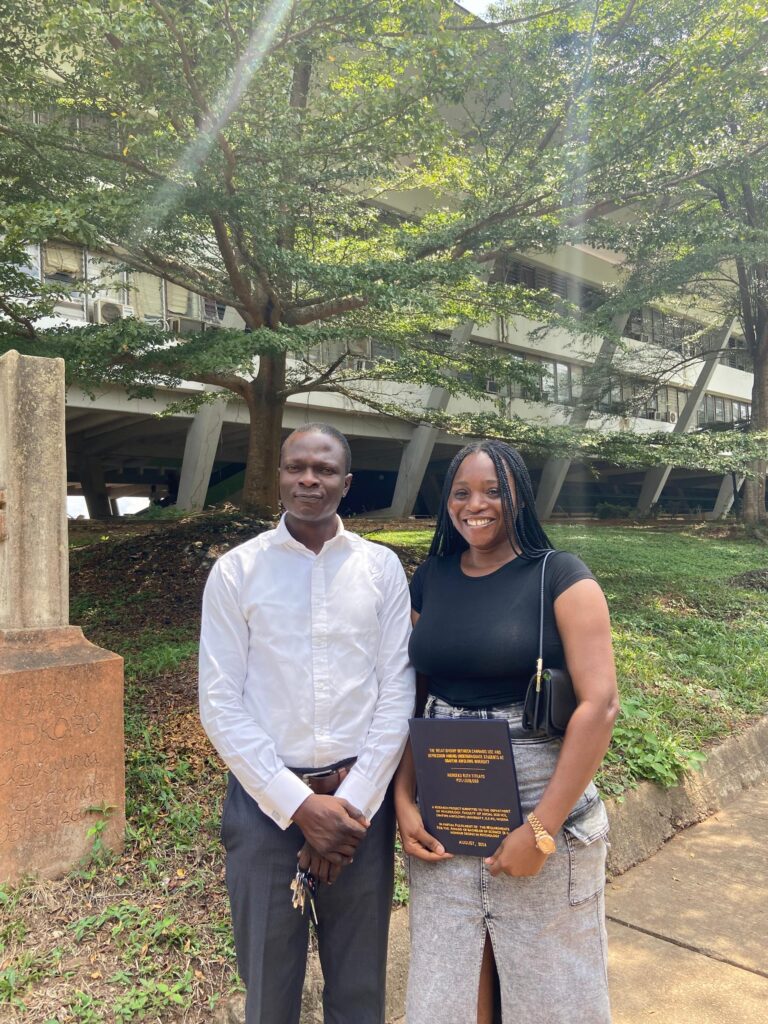
Coping, for Ruth, is a mix of raw honesty and gentle rituals. Sleep and tears are two of her most surprising but sacred tools.
“Whenever I say this, some people look at me funny, but I genuinely feel better after a good cry or sleep. Honestly, this helps me wake up with clearer vision and effectively address the root cause of whatever issue I’m facing. Then I can plan strategies and actively work towards solutions.”
A long nap or a heartfelt cry offers her clarity, a moment of reset that allows her to step back into herself.
“Of course, I can’t cry over every problem. So sometimes I turn to music and writing. Writing is a therapeutic outlet for me, I can write how I feel and better understand myself, it helps me work through the emotions.”
So when those aren’t enough, she turns to music and writing, spaces where she can translate emotions into sound and language, anchoring herself with words. Her support system plays a vital role too. Friends, family, and especially her younger sister, are her emotional lifelines, her “anchors to this world,” as she calls them.
“I also never take support from close friends and family for granted, especially my younger sister. I call them my anchors to this world, keeping me grounded. They are my support systems, providing listening ears when I just want to rant about whatever is bothering me and somehow I feel better and lighter.”
When negative thoughts creep in and whisper that she’s not enough, these relationships offer perspective, comfort, and strength.
Still, even with these coping tools, there are days when the clouds refuse to lift. On those days, she lets herself feel, momentarily, but doesn’t stay there. She leans on one truth that has helped her reclaim her mind repeatedly: it’s not just the event that breaks us, but how we perceive it.
“Sure, there are days I want to wallow and let negative thoughts consume me. But I take the extra step to reconfigure those thoughts and seek positives. One key to better mental wellbeing? Challenging how we perceive events, because these interpretations profoundly affect our emotions.”
Ruth Akindeko
The Weight of Empathy
Caring deeply can be both empowering and exhausting. For Akindeko Ruth Titilayo, pursuing psychology hasn’t just been about learning how the mind works, it’s also meant learning how to care for others without losing sight of herself. Her journey is one of constantly balancing the weight of empathy with the need for personal well-being. As someone often looked up to for strength, she has quietly carried emotional loads while learning to forgive herself for being human. Her advice to fellow psychology students who feel weighed down by invisible burdens is simple: Remember you’re human first.
“Remember you’re human first. Be careful not to overwhelm yourself in your mission to show up for others. There’s no shame in reaching out for help from the right sources, take care of yourself so you can care for others well.”
Ruth Akindeko Titilayo
Ruth acknowledges that one of the hardest parts of this journey is reconciling the two sides of herself, the helper and the hurting. There are days when she applies all the tools in her mental health toolkit and still finds herself coming undone. But instead of condemning those moments, she’s learning to welcome them.
“It starts with being completely honest with myself, accepting that I am human first and a psychology student second. Even when I still fall apart after applying these coping strategies, I remind myself that breaking down does not disqualify my expertise, rather, it deepens it. I use these moments to reflect and re-strategise. I am learning that knowing better does not always mean doing better. Growth is a journey, not a destination.”
Admitting she’s not okay doesn’t threaten her identity as a future psychologist, it deepens it. It’s in those moments of collapse and re-centering that her self-awareness sharpens. She reminds herself, often gently: Knowing better doesn’t always mean doing better. Growth, for her, is a layered, evolving process.
Guilt has also been a familiar companion. In a world that often expects mental health professionals to “have it all together,” Ruth has grappled with the discomfort of being a guide while still feeling lost. She has felt the internal pressure to uphold an image of stability, especially when others look to her for support. In these moments, guilt whispers that she should be stronger, wiser, less shaken. But she counters that voice with truth: struggling does not mean failing.
“Studying psychology hasn’t made me superior, it’s simply given me deeper insight into coping with these challenges. And that helps ease the guilt.”
Her education in psychology hasn’t granted her immunity to pain, it has equipped her with the language and tools to understand it more clearly.
Being vulnerable about her challenges hasn’t always come easily, but Ruth believes it has made her a more effective advocate. When she opens up about her experiences, she not only liberates herself but also creates space for others to be honest too. Her vulnerability becomes an invitation, breaking the silence that often surrounds mental health. Through these shared conversations with peers and mentors, she’s come to see that she is far from alone. And that solidarity, the quiet nod of ‘me too‘, is what keeps her going.
In the end, Ruth sees empathy not as a muscle she’s had to strengthen through pain. Her transparency, rather than complicating her advocacy, has rooted it in lived truth. And in that truth, others find permission to breathe, to be seen, and to begin healing.
Becoming the Bridge: From Survivor to Professional
The path from pain to purpose is rarely linear, but for Akindeko Ruth Titilayo, it has been transformative. Her personal experiences with anxiety and depression during her psychology studies didn’t just shape her, they refined her. They exposed her to the silent battles often buried beneath academic pursuits and daily responsibilities, forcing her to confront the reality that even those training to help others sometimes need help themselves.
It was through this lived struggle that Ruth learned some of her deepest lessons. She understands now, in ways few can teach, the isolating silence of mental illness and the lifesaving power of empathy and support. Her journey has instilled in her a profound commitment: to become the kind of mental health professional who is not just informed, but deeply humane. She aspires to be approachable and relatable, creating spaces where people feel truly seen. Her goal is to use her own story as a bridge, linking lived experience with clinical care, and breaking down stigma along the way.
To those walking a similar road, especially fellow students and professionals in helping fields, Ruth offers a reminder: you’re not alone. Being in a caregiving role doesn’t exempt one from emotional suffering. In fact, sometimes it amplifies it. She speaks candidly about the reality of vicarious trauma, also known as secondary trauma, how listening to others’ pain can slowly wear down one’s own mental defenses. Her advice? Prioritize your wellness. Protect your peace. Understand that setting boundaries isn’t selfish, it’s a form of self-respect. Healing others does not mean abandoning yourself.
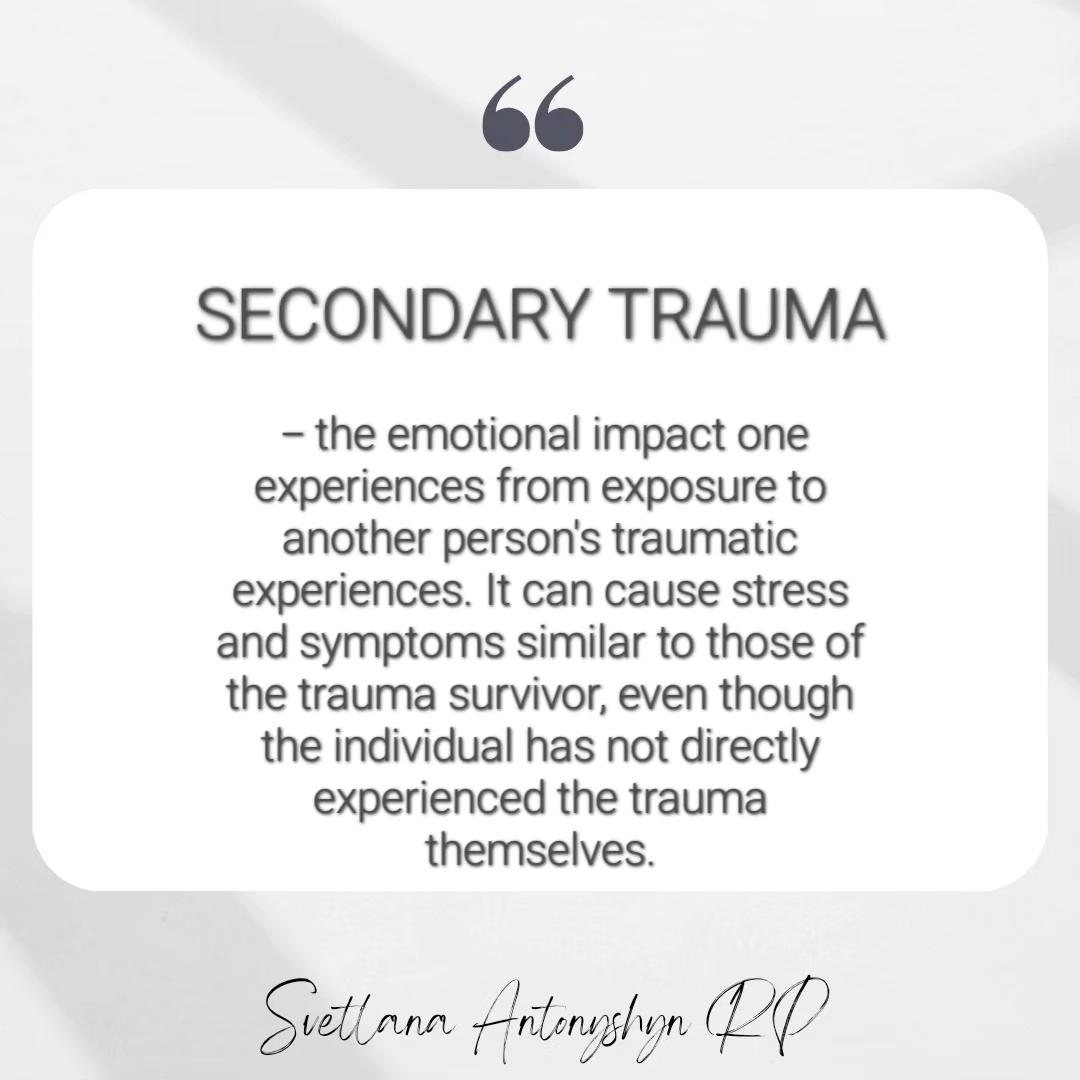
She also challenges the common misconception that psychology students somehow “have it all together.” Beneath the clinical knowledge and academic achievements are real people, many of whom chose this path precisely because they know what it feels like to break. Ruth hopes more people recognize this humanity, and by doing so, offer grace rather than judgment.

Ruth’s story is not just one of surviving, it’s about becoming. Becoming a bridge. Becoming a voice. Becoming a safe haven for those who have known pain and are searching for peace. And in doing so, she reminds us all that healing is both personal and collective. In sharing her story, she plants a flame, that others too might shed their shame. By sharing her story, may many rise, encouraged, free, to heal, to hope, to simply be.

- The Rise of Suicide Posts in Digital Spaces Reflects a Growing Mental Health Crisis - February 22, 2026
- How Kenya’s Silent Lifestyle Disease Crisis Is Reshaping Public Health - February 12, 2026
- The Rise of Lifestyle Diseases Emerges as a Crisis Among Kenya’s Youth - February 9, 2026