When a government switches off social media, the silence is never just digital.
In countries such as Gabon, where authorities have imposed restrictions on major platforms during periods of political tension, the refresh button suddenly stops working. Timelines freeze. Messages fail to send. For millions, the digital spaces that function as newsrooms, marketplaces, and public squares vanish in an instant.
But what disappears in those moments is more than content. It is participation.
Across Africa, social media platforms have evolved into something far greater than tools for social connection. They are now embedded in the architecture of civic life. When governments suspend access to them, whether during elections, protests, or unrest, the act reverberates far beyond the screen. It reshapes how information flows, how economies function, and how citizens experience belonging in modern society.
The Platform as Infrastructure
In many African countries, digital life is mobile-first. For millions of users, social media platforms such as Facebook, WhatsApp, and X are not simply entertainment hubs. They are essential infrastructure.
Small businesses rely on WhatsApp groups to coordinate orders and payments. Activists organise demonstrations through Facebook posts and live streams. Journalists gather eyewitness accounts via X threads. During emergencies, citizens turn to social feeds for real-time updates faster than traditional broadcast channels can provide.
In effect, these platforms have become informal utilities, privately owned but publicly indispensable.
When access is cut, the disruption is not symbolic. It is systemic. Economic transactions stall. Independent reporting slows. Diaspora communities lose contact with events unfolding at home. The digital bloodstream of society is constricted.
The shutdown, then, is not merely a communications tactic. It is an intervention into the infrastructure of everyday life.
The Political Logic of Silence
Governments typically justify social media shutdowns as necessary safeguards. Officials cite concerns about misinformation, incitement to violence, or threats to national security. In moments of volatility, the argument goes, restricting digital channels prevents rumors from spiraling into unrest.
Yet critics argue that shutdowns often function less as protective measures and more as instruments of narrative control. By limiting citizen-generated content and real-time reporting, authorities can narrow the range of visible perspectives. In environments where independent media ecosystems are already fragile, this imbalance becomes more pronounced.
The tension reflects a broader global debate about digital sovereignty. Who ultimately controls the digital public square multinational tech companies, elected governments, or the citizens who populate these spaces?
In Africa, where platform adoption has surged faster than regulatory frameworks have evolved, that question remains unsettled. Shutdowns are one way states assert authority over digital space. But they also expose the fragility of online freedoms that many users had begun to take for granted.
Journalism Under Interruption
Modern journalism in Africa is deeply intertwined with social media platforms. Mobile reporting tools allow journalists to livestream events, verify footage through crowd-sourced content, and distribute stories instantly.
When platforms go dark, the reporting cycle fractures.
Real-time uploads become impossible. Citizen videos cannot be easily shared or authenticated. Newsrooms lose access to primary sources embedded within digital communities. In some cases, international correspondents must rely on fragmented SMS updates or secondhand accounts.
Journalists and riot police take cover as tear gas is fired to disperse opposition CORD protesters outside the electoral commission headquarters in Nairobi, Kenya, May 9, 2016. (REUTERS/Thomas Mukoya)
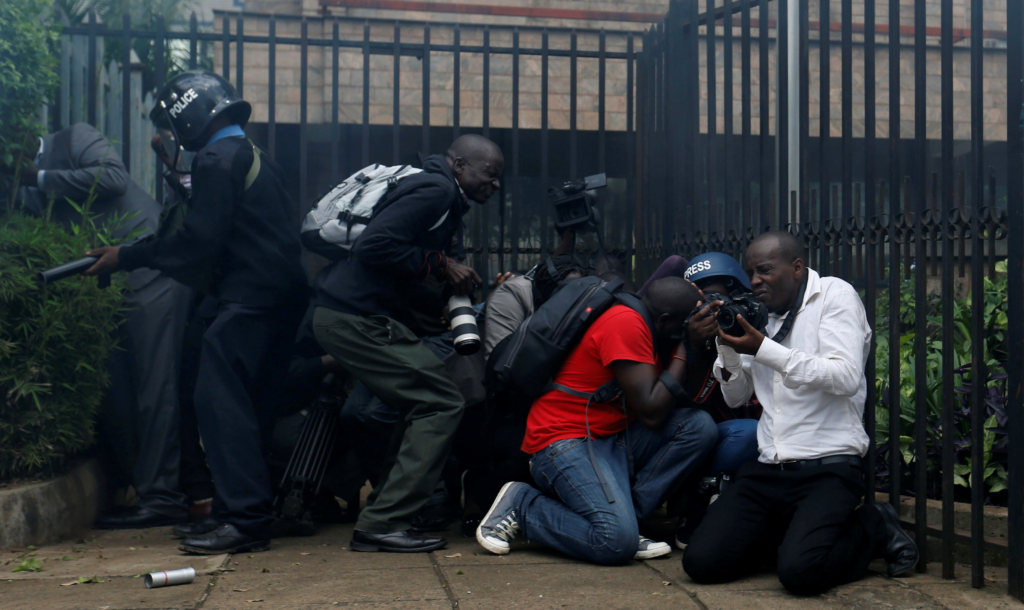
The result is a widening information gap on social media.
State-aligned narratives may continue through official channels, but independent voices struggle to reach audiences. For diasporic communities dependent on social media for updates, the blackout creates both informational and emotional distance.
A shutdown, in this sense, is not only a technological event. It is an editorial one.
Digital Workarounds and Resilient Citizens
Yet digital silence rarely remains absolute.
History shows that shutdowns on social media often trigger spikes in virtual private network (VPN) usage. Tech-savvy citizens quickly circulate instructions on how to bypass restrictions. Alternative platforms gain temporary traction. Encrypted messaging becomes more common.
There is a paradox embedded here: efforts to suppress digital expression frequently accelerate digital literacy.
Each shutdown becomes a crash course in circumvention. Citizens learn about DNS blocking, proxy servers, and encryption tools. Activists diversify their communication strategies. Journalists experiment with decentralised distribution methods.
In attempting to reassert control, authorities may inadvertently cultivate a more technologically agile public.
This resilience complicates the effectiveness of social media shutdowns. While they may temporarily reduce visibility, they can also deepen distrust between governments and digitally engaged citizens and encourage a shift toward harder-to-monitor channels.
The Economic Cost of Going Dark
The political and journalistic consequences of shutdowns often dominate headlines. Less discussed are the economic ripple effects.
Across the continent, informal entrepreneurs use Facebook pages as storefronts and WhatsApp chats as customer service lines. Digital payment systems are integrated into messaging platforms. Influencers and content creators depend on daily engagement to sustain income streams.
When platforms are suspended, these micro-economies stall.
Lost days online translate into lost revenue. For small vendors operating on thin margins, even brief disruptions can have an outsized impact. In economies where youth unemployment remains high, digital entrepreneurship has become a crucial outlet. Shutdowns place that fragile ecosystem at risk.
Connectivity, in this sense, is not just about speech. It is about survival.
The Psychology of Digital Silence
Beyond economics and politics lies a subtler dimension: the psychological impact of disconnection.
In highly connected societies, social feeds function as ambient awareness systems. They provide a sense of presence of knowing what is happening, of being part of a collective conversation.
When that stream suddenly stops, uncertainty expands.
Rumours may circulate offline, unverified and amplified by word of mouth. Anxiety intensifies as official statements replace peer-to-peer dialogue. Diaspora communities experience acute disorientation, cut off from real-time updates about loved ones.
Digital silence on social media is rarely neutral. It carries emotional weight.
For younger generations who have grown up with smartphones as extensions of identity, the interruption can feel like a narrowing of personal space. The shutdown becomes not only a political act, but a cultural one, a reminder that digital belonging remains contingent.
A Continental and Global Pattern
While Gabon provides a recent illustration, social media shutdowns are not confined to a single nation. Across Africa and indeed globally, temporary digital blackouts have become recurring features of political management.
This pattern raises urgent questions across social media. Are we moving toward a fragmented internet where access is conditional and context-dependent? Will platform companies negotiate new frameworks with governments, or continue navigating these tensions on a case-by-case basis?
Africa sits at a pivotal point in this conversation. The continent is one of the world’s fastest-growing digital markets. Mobile connectivity continues to expand. Youth populations are deeply engaged online. The stakes of digital governance will only intensify.
The Future of the African Digital Public Square
As shutdowns on social media recur, they risk normalization. What once provoked international outcry can gradually become an expected feature of election cycles or political unrest.
Yet normalisation does not equal acceptance.
Civil society organisations across the continent continue advocating for digital rights protections. Legal challenges in some jurisdictions have questioned the proportionality and economic impact of shutdowns. Meanwhile, citizens adapt, innovate, and persist.
The deeper question may not be whether shutdowns will continue, but what they reveal.
They reveal how essential digital platforms have become to modern citizenship. They reveal the unresolved struggle between state authority and networked publics. And they reveal the fragility of online freedoms in environments where regulatory and democratic institutions are still evolving.
When the timeline goes dark on social media, the silence forces a reckoning.
In an era where public life increasingly unfolds online, switching off platforms is no longer about silencing apps. It is about redefining who controls visibility, voice, and participation itself.
And in Africa’s rapidly expanding digital landscape, that struggle is only just beginning.

- When Platforms Fall Silent: Social Media Shutdowns and the Battle for Digital Expression in Africa - February 24, 2026
- Social Media Is the Greatest Threat to Democracy. Prove Me Wrong - February 19, 2026
- Thursday TBT Zilizopendwa: Embe Dodo by Them Mushrooms - February 12, 2026